
For the 2026 school year, there are 6 public high schools serving 1,953 students in Boone County, AR.
The top-ranked public high schools in Boone County, AR are Valley Springs High School, Bergman High School and Harrison High School. Overall testing rank is based on a school's combined math and reading proficiency test score ranking.
Boone County, AR public high schools have an average math proficiency score of 33% (versus the Arkansas public high school average of 27%), and reading proficiency score of 50% (versus the 40% statewide average). High schools in Boone County have an average ranking of 10/10, which is in the top 10% of Arkansas public high schools.
Boone County, AR public high school have a Graduation Rate of 93%, which is more than the Arkansas average of 89%.
The school with highest graduation rate is Harrison High School, with 96% graduation rate. Read more about public school graduation rate statistics in Arkansas or national school graduation rate statistics.
Minority enrollment is 8% of the student body (majority Hispanic), which is less than the Arkansas public high school average of 41% (majority Black).
Best Public High Schools in Boone County (2026)
School
(Math and Reading Proficiency)
(Math and Reading Proficiency)
Location
Quick Facts
Rank: #11.
Valley Springs High School
(Math: 40-44% | Reading: 55-59%)
Rank:
Rank:
8/
Top 30%10
7349 School Str
Valley Springs, AR 72682
(870) 302-3051
Valley Springs, AR 72682
(870) 302-3051
Gr: 9-12 | 219 students Student-teacher ratio: 5:1 Minority enrollment: 4%
Rank: #22.
Bergman High School
(Math: 35-39% | Reading: 55-59%)
Rank:
Rank:
8/
Top 30%10
8949 Highway 7 N
Bergman, AR 72615
(870) 741-1414
Bergman, AR 72615
(870) 741-1414
Gr: 9-12 | 297 students Student-teacher ratio: 4:1 Minority enrollment: 11%
Rank: #33.
Harrison High School
(Math: 40% | Reading: 54%)
Rank:
Rank:
8/
Top 30%10
925 Goblin Drive
Harrison, AR 72601
(870) 741-8223
Harrison, AR 72601
(870) 741-8223
Gr: 9-12 | 843 students Student-teacher ratio: 7:1 Minority enrollment: 11%
Rank: #44.
Alpena High School
(Math: 25-29% | Reading: 40-44%)
Rank:
Rank:
5/
Bottom 50%10
300a South Denver
Alpena, AR 72611
(866) 425-7362
Alpena, AR 72611
(866) 425-7362
Gr: 7-12 | 183 students Student-teacher ratio: 3:1 Minority enrollment: 9%
Rank: #55.
Omaha High School
(Math: 20-24% | Reading: 40-44%)
Rank:
Rank:
5/
Bottom 50%10
522 W. College Rd
Omaha, AR 72662
(870) 433-2453
Omaha, AR 72662
(870) 433-2453
Gr: 7-12 | 171 students Student-teacher ratio: 3:1 Minority enrollment: 11%
Rank: #66.
Lead Hill High School
(Math: 10-14% | Reading: 40-44%)
Rank:
Rank:
4/
Bottom 50%10
6966 Milum Drive
Lead Hill, AR 72644
(870) 436-0506
Lead Hill, AR 72644
(870) 436-0506
Gr: 7-12 | 185 students Student-teacher ratio: 7:1 Minority enrollment: 9%
Frequently Asked Questions
What are the top-ranked public high schools in Boone County, AR?
The top-ranked public high schools in Boone County, AR include Valley Springs High School, Bergman High School and Harrison High School.
How many public high schools are located in Boone County?
6 public high schools are located in Boone County.
What is the racial composition of students in Boone County?
Boone County public high schools minority enrollment is 8% of the student body (majority Hispanic), which is less than the Arkansas public high schools average of 41% (majority Black).
Which public high schools in Boone County are often viewed compared to one another?
Popular comparisons of public high schools in Boone County include: Bergman High School vs. Harrison High School, Harrison High School vs. Bergman High School, Valley Springs High School vs. Bergman High School
Recent Articles

AI Report Cards: Should Schools Evaluate AI Use?
Explore whether schools should assess student AI use, the benefits, risks, and what responsible AI report cards could look like in 2026.

The Parent’s Guide to School Cell Phone Bans in 2026
Learn how school cell phone bans work in 2026, why districts are adopting them, and what parents should expect.
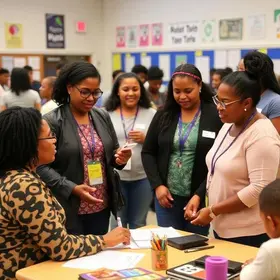
Parental Involvement in Public Schools: 2026 Update
Explore the latest 2026 trends, research, and strategies shaping parental involvement in public schools and student success.