Evaluating Public Schools

This section provides tools to aid in finding the best public school option for your child. Compare private and public schools, explore school zoning issues, and delve into the public school grading and ranking system. Find information on the safest schools and what they are doing right.

View the most popular articles in Evaluating Public Schools:

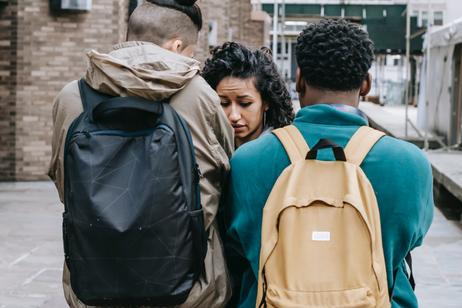
Protecting Public School Students from “Sexting”

Warning: mkdir(): Permission denied in /home/devsarath/workspace/psr/public_html/include/srn_lib/psr/misc/QuickPhotos.inc.php on line 24 Warning: mkdir(): Permission denied in /home/devsarath/workspace/psr/public_html/include/srn_lib/psr/misc/QuickPhotos.inc.php on line 24 Warning: mkdir(): Permission denied in /home/devsarath/workspace/psr/public_html/include/srn_lib/psr/misc/QuickPhotos.inc.php on line 24 Warning: mkdir(): Permission denied in /home/devsarath/workspace/psr/public_html/include/srn_lib/psr/misc/QuickPhotos.inc.php on line 24
Updated
|
Protecting Public School Students from “Sexting”
Sexting can result in dangerous consequences, including instances of suicide. Learn about what public schools and parents can do to keep students safe from the ramifications of sexting.

Several years ago, the word “sexting” was not part of American vernacular. Unfortunately, in the past year, the word has become a part of our society, permeating news articles as a description of a disturbing trend: teenagers sending sexually explicit photos of themselves and other teens using their cell phones.

The Unfortunate Consequences of Sexting

The trend became the focus of increased attention after a high school student’s suicide in July 2008 was attributed to sexting. Jessica Logan, a senior at an Ohio high school, had sent nude photos of herself to a boyfriend.

After the relationship ended, her ex-boyfriend sent the photos to other female students at Logan’s school, which resulted in months of harassment and teasing for Logan. Logan reported, according to MSNBC, that the other girls called her a "slut" and a "whore," and that the teasing was so disruptive that she began to skip school. Logan hung herself one month after her high school graduation.

Logan’s parents recently filed suit against the high school and several other defendants, alleging that the school and the local police did not do enough to protect their daughter from being bullied and harassed, reports the Cincinnati Enquirer.

According to a recent study commissioned by the National Campaign to Prevent Teen and Unplanned Pregnancy and CosmoGirl.com, “20 percent of teenagers have taken nude or semi-nude pictures or videos of themselves and sent them to someone or posted them online,” reports the New York Times blog

. . .read more

Can Students Be Legally Prosecuted for School Fights?

Updated
|
Can Students Be Legally Prosecuted for School Fights?
This comprehensive guide explores the increasing trend of legal prosecution for school fights, discussing recent incidents, age considerations, and the shift from traditional school punishments to law enforcement involvement. It provides valuable insights for parents, educators, and students about the evolving landscape of school discipline and safety measures.

The consequences for school fights may no longer be limited to a visit to the principal’s office and detention. In recent years, concerns about school safety, social media-fueled conflicts, and high-profile incidents of campus violence have led many districts to involve law enforcement more quickly when fights break out.

Over the past several years, schools across the country have reported fluctuations in student behavior following pandemic-related disruptions. Federal data from the National Center for Education Statistics has shown increases in reported physical altercations and disciplinary incidents during the return to in-person learning.

School Fights: The Rising Threat

Public schools nationwide report more severe punishments for school fights and student misbehavior. For example, in some communities, large-scale fights have required significant police presence. According to reports, the police were called to the school after multiple fights broke out among students.

Students involved faced charges such as disorderly conduct and simple affray. In cases where students allegedly assaulted school resource officers or staff members, more serious charges were added.

While students 18 and older are understandably tried as adults, many community members question whether the 16 and 17-year-old students should have been similarly reprimanded, as they are technically minors.

This video discusses how to deal with fighting in school.

School leaders often argue that when large groups are involved, or when weapons or staff injuries are reported, law enforcement involvement is necessary to protect students and faculty.

. . .read more

Should My Child Enroll in Honors Or General Courses?

Updated
|
Should My Child Enroll in Honors Or General Courses?
Deciding between honors and general courses for your child's education is a critical choice. This article explores key considerations such as understanding the differences between these courses, assessing your child's academic strengths and aspirations, and seeking expert advice to make an informed decision. With insights from educators and real-life examples, parents can confidently navigate this decision to ensure their child's academic success and fulfillment.

When picking classes for the next school year, parents often fret over whether their kids should dive into honors courses. These classes offer more challenges, but do they mean sacrificing top grades? It's a dilemma: better marks or tougher academics? With honors courses demanding extra effort, it's a tough call. So, here are some insights from school and college pros that can help students navigate this critical decision.

Honors vs. General: What's the Big Difference?

While each state and school community has curriculum standards, most honors and general courses adhere to similar philosophical practices. For example, Wake County Public Schools, one of the largest school systems in North Carolina, divides its high school courses into "honors" and "academic" (average) tracks. In examining the differences in Wake County Schools' 9th grade English course options, parents and students can discuss the similarities and differences between the honors and academic options.

  • Honors 9th Grade English: Students in both honors and academics must read specific texts from a county-wide reading list. An honors course, however, will generally read more texts than an academic course, as the honors course is conducted at a much faster pace. To work more rapidly through diverse materials, honors students will undoubtedly be assigned more homework than an academic class. Additionally, suppose a student in an honors course falls behind or is struggling. In that case, the student must typically seek out tutoring assistance during their own time (during lunch, before/after school, etc.), as
. . .read more

What You Need to Know about Emergency Response Procedures in Public Schools

Warning: mkdir(): Permission denied in /home/devsarath/workspace/psr/public_html/include/srn_lib/psr/misc/QuickPhotos.inc.php on line 24 Warning: mkdir(): Permission denied in /home/devsarath/workspace/psr/public_html/include/srn_lib/psr/misc/QuickPhotos.inc.php on line 24 Warning: mkdir(): Permission denied in /home/devsarath/workspace/psr/public_html/include/srn_lib/psr/misc/QuickPhotos.inc.php on line 24 Warning: mkdir(): Permission denied in /home/devsarath/workspace/psr/public_html/include/srn_lib/psr/misc/QuickPhotos.inc.php on line 24
Updated
|
What You Need to Know about Emergency Response Procedures in Public Schools
Learn about how public schools are protecting students against emergencies, and what parents need to know about keeping their children safe in public schools.

In the wake of nearly 10 years of increased school violence, all public schools are legally required to possess specific lockdown and emergency response procedures. Specifically, middle schools and high schools, which experience greater safety breaches due to their age groups, should frequently practice their emergency response protocols to ensure that all students and staff are ready to respond in the rare case of a serious emergency or threat. An awareness of the public school’s emergency protocols can help protect all community members—especially the students.

This video outlines how to set up a protocol for handling a crisis situation.

Types of Emergency Response

Public schools have different “threat levels” that result in specific emergency responses. For example, Montgomery Public Schools in Rockville, Maryland employ two specific threat level procedures. The first type of threat is labeled as “code blue.” A “code blue” threat signifies that there is an emergency or serious crisis near the school. In the case of a “code blue,” all Montgomery administrators announce appropriate information to the whole school, resulting in immediate teacher response.

Teachers in a “code blue” situation are to ensure that no students in the building are unsupervised. Classroom instruction continues, however, students are not permitted to leave the building unsupervised. While a “code blue” can potentially turn into a serious situation, this type of threat is generally not a

. . .read more

Year-Round Or Traditional Schedule?

Warning: mkdir(): Permission denied in /home/devsarath/workspace/psr/public_html/include/srn_lib/psr/misc/QuickPhotos.inc.php on line 24 Warning: mkdir(): Permission denied in /home/devsarath/workspace/psr/public_html/include/srn_lib/psr/misc/QuickPhotos.inc.php on line 24 Warning: mkdir(): Permission denied in /home/devsarath/workspace/psr/public_html/include/srn_lib/psr/misc/QuickPhotos.inc.php on line 24 Warning: mkdir(): Permission denied in /home/devsarath/workspace/psr/public_html/include/srn_lib/psr/misc/QuickPhotos.inc.php on line 24
Updated
|
Year-Round Or Traditional Schedule?
Which is more appropriate for your child? A year-round attendance schedule or traditional schedule? We look at the pros and cons.

Year-Round Or Traditional Schedule?

For a variety of reasons, schools across the country are switching their schedules to a year-round curriculum.

  • This means that both students and teachers no longer have the traditional two months of summer vacation.
  • While some parents enjoy the year-round schedule, others engage in a heated debate about the new trend.
  • Some schools are implementing the year-round program to maintain more consistent instruction.
  • Other schools are switching in order to save money.

While many parents are concerned about the potential change for their children and family, each schedule offers its own pros and cons.

This video from PBS examines the pros and cons of year-round schools.

The Year-Round Calendar

When using the term “traditional calendar,” most schools are referring to the most popular schedule, where students and teachers are able to have an extended summer vacation, in addition to the standard holiday breaks throughout the school year.

  • According to data from the National Center for Education Statistics, 86 percent of public schools in the United States operate on a traditional calendar, even though it’s the original purpose – so that children could help parents harvest crops – is no longer an important consideration.
  • Since the traditional summer vacation is no longer “essential,” some experts maintain that continuing to use the traditional calendar is not what’s best for today’s children.
  • As schools are now experimenting with the year-round schedules, many
. . .read more

Recent Articles

The ROI of Public High School in 2026: Which Programs Actually Improve College and Career Outcomes?
Which public high school programs deliver real college and career results in 2026? Compare AP, IB, dual enrollment, CTE, and early college outcomes.
Spring Parent-Teacher Conferences: Key Questions
Spring Parent-Teacher Conferences: Questions Every Parent Should Ask to support academic growth, social development, and 2026 classroom goals.
Prepare for Spring Tests Without Anxiety
Learn how to prepare for spring standardized tests without increasing anxiety using proven strategies for families and schools.

Evaluating Public Schools

SCHOOL ZONING
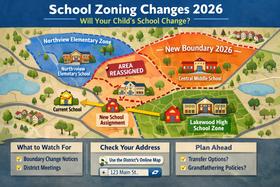
Learn more about zoning rules, how they impact schools and your child. This section offers information on the history of school zones, what they are, and how they work. Get information on who decides school boundaries and the impact those decisions have on the community.
GETTING STARTED
An overview of school designations, best practices for evaluating your options, and tips on choosing the best school for your child. Learn about Blue Ribbon, Vocational and Special Education schools. Get tips on finding the right school in a new neighborhood, city or state.
GRADING AND RANKING SCHOOLS
Explore the public school grading/ranking system, how it works and what it means. Get latest national rankings and read what critics of school grading have to say. Take a look at the nation’s top performing schools as ranked by U.S. News and Newsweek.
PUBLIC SCHOOL SAFETY
A comprehensive look at the safety of US public schools. Learn what schools are doing to combat gangs and drugs, prepare for natural disasters, and protect your children from predators. From web cameras to armed guards, see what tools public schools are employing to keep kids safe.
PUBLIC VS. PRIVATE SCHOOLS
A comparison of public and private schools, the pros and cons of each, and a look at the cost of getting a stellar education at both. Take a look at some of the most expensive schools, notable public school alumni, and learn more about “private” public schools.
Notice: Javascript file does not exist: /home/devsarath/workspace/psr/public_html/javascript/components/popper.min.js in /home/devsarath/workspace/psr/public_html/include/srn_lib/shared/misc/JSCompiler.inc.php on line 241 Notice: Javascript file does not exist: /home/devsarath/workspace/psr/public_html/javascript/components/tippy.min.js in /home/devsarath/workspace/psr/public_html/include/srn_lib/shared/misc/JSCompiler.inc.php on line 241 Notice: Directory does not exist in /home/devsarath/workspace/psr/public_html/include/srn_lib/shared/misc/JSCompiler.inc.php on line 241 Notice: Unable to save compiled js file in /home/devsarath/workspace/psr/public_html/include/srn_lib/shared/misc/JSCompiler.inc.php on line 241