Updated
|
Voucher Program Update: Florida
Many states now offer voucher programs. We look at the voucher program available in Florida.

I wrote my first article on vouchers in 2008. While the media portrays it as a controversial issue, I have always tried to take a balanced approach when I write about vouchers. School Choice: Vouchers, Scholarships, and More; Vouchers aka Tax Credits and Scholarships; What Strings Do School Vouchers Have Attached?; Charter Schools and Vouchers illustrate my thoughts on the subject.

This time, because so much more information about voucher programs is available, I asked an authoritative source to answer my questions on your behalf.

Rob K: What is the purpose of a private school voucher program?

ChatGPT: A private school voucher program aims to provide families with publicly-funded scholarships or vouchers that can be used to pay for tuition at private schools rather than at public schools. The goal of such programs is typically to increase school choice and provide families with access to educational options that they might not otherwise be able to afford.

Proponents of voucher programs argue that they promote competition among schools and can help improve education quality by giving families more options and forcing schools to compete for students. They also argue that voucher programs can help to reduce educational inequality by providing low-income families access to high-quality private schools that they might not otherwise be able to afford.

Critics of voucher programs argue that they divert public funds away from public schools, which can lead to reduced resources and

. . .read more

Have Smartphones Ruined Public Education?

Updated
|
Have Smartphones Ruined Public Education?
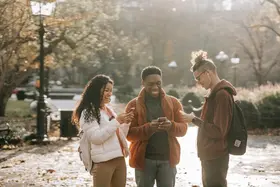
I used to think that students having smartphones in school was a bad thing. Not any more. Here are my reasons why.

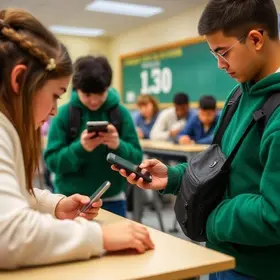
The short answer is "No!" As a parent, grandparent, and former teacher, I assumed the answer would be "Yes!" Smartphones are everywhere. Young people spend hours staring at those tiny screens. They most certainly can be a distraction. But the bottom line is that smartphones are affordable communication tools for students from various socio-economic levels.

Advantage No. 1

The whole point of K-12 education is to teach young people how to think critically, analyze information, and organize academic work and other related activities. Smartphones are incredibly efficient for managing all kinds of data. Teaching a young person how to organize her work, take notes, and set reminders lays the groundwork for success in whatever endeavors she takes up after graduating high school.

Advantage No. 2

Smartphones level the playing field by making a powerful computing tool available to students who otherwise could not afford a traditional laptop, desktop computer, or tablet. Smartphones are also invaluable when textbooks are not available.

Advantage No. 3

With the advent of smartphones and their tremendous computing power came apps. So I asked ChatGPT for a list of educational apps, and this is what it produced:

  1. Kahoot!: This app allows teachers to create quizzes and games for their students, which can be played in the classroom or remotely.
  2. Duolingo: Duolingo is a language learning app providing interactive lessons in dozens of languages.
  3. Khan Academy: Khan Academy offers a wide range of free online courses and lessons in subjects such as math, science, and history.
  4. Quizlet: Quizlet
. . .read more

Prevent Suicide

Updated
|
Prevent Suicide
988 is the suicide and crisis lifeline. Parents, teachers, and students can help prevent suicide once they know the warning signs.

The nation got a new Suicide Hotline on July 16, 2022. All somebody has to do is dial 988 to speak with a trained counselor. 24/7

988 has been designated as the new three-digit dialing code that will route callers to the National Suicide Prevention Lifeline (now known as the 988 Suicide & Crisis Lifeline), and is now active across the United States.

When people call, text, or chat 988, they will be connected to trained counselors that are part of the existing Lifeline network. These trained counselors will listen, understand how their problems are affecting them, provide support, and connect them to resources if necessary. Source: 988 Suicide and Crisis Lifeline

Before we discuss suicide in more detail, please print out the logo above and pin it to your kitchen noticeboard. Then, tell your children what 988 is and what it is used for, so they can help somebody in need the same way they do by knowing how and when to call 911.

This video explains how the 988 suicide and crisis lifeline works.

Suicide: The Subject Nobody Wants To Talk About

Suicide knows no age limits. It is shocking and tragic, no matter how or when it occurs. It scatters guilt widely as the friends and loved ones of the deceased wonder what they could have done to prevent somebody from taking her life. What subtle warning signs

. . .read more

Teaching: Using Virtual Reality

Updated
|
Teaching: Using Virtual Reality
Virtual Reality can enhance your lessons safely and efficiently. Virtual reality allows your students to explore worlds they might not otherwise see. We offer some suggestions on how to use VR in your classroom.

I've always been a fan of online courses. Kahn Academy and MOOC caught my attention years ago as excellent ways to enrich both my classroom lessons and my own children's learning experiences. As an old teacher, I can remember enhancing my lessons with slides and dial-up modem connections with some of the early Internet websites. I was teaching Latin to middle school students. The resources I discovered even way back in the 90s captured the imagination of my students and made the subject matter come alive. So, thirty years later, I am amazed at the breadth and depth of the resources available to parents and teachers.

The Purpose of Virtual Reality

These days, taking a class on a field trip poses all kinds of challenges. The cost, the approvals required from parents and guardians, the liability issues, and so on make school-sponsored excursions outside the school campus challenging to organize. Virtual Reality, combined with the high-resolution screens available on laptops and wide-screen TVs and monitors, is the next best thing to being there. As noted previously, it's safer and infinitely easier to manage.

How to use VR in your classroom

Finding out how to use virtual reality in your classroom involves discovering what resources are available and discussing how you may use them in your classroom.

For years, I’ve taken joy in introducing virtual reality to educators at different schools. Armed with cheap Google Cardboard viewers, Lenovo Daydream headsets, and free access to Google Expeditions and Tour Creator,

. . .read more

Junior Reserve Officers Training Corps or JROTC

Updated
|
Junior Reserve Officers Training Corps or JROTC
JROTC offers valuable lessons in leadership, character-building and citizenship. Here's a look at the various JROTC programs out there together with a look at the pros and cons of the program.
Wikimedia.commons.org, public domain/PH3 Victoria A. Tullock, USN

Junior Reserve Officers Training Corps or JROTC

I was disappointed to read the story in the New York Times about abuse in an Army JROTC program. Why? Because I've always thought very highly of the program available in over 1700 public and private high schools. I will further disclaim that my eldest daughter was in the ROTC program at MIT while she was at Harvard. So, I know first-hand that it is well-run for the most part. The JROTC does an immense amount of good for young people at the high school level.

What is JROTC?

Congress established the JROTC or Junior Reserve Officers Training Corps in 1916. Each branch of the services has its own distinctive JROTC program. However, they all have the altruistic-sounding mission "To Motivate Young People to be Better Citizens."

The U.S. Army Junior Reserve Officers’ Training Corps (JROTC) is one of the largest character development and citizenship programs for youth in the world. Source: JROTC

  • Some people think that JROTC is a recruiting program for the military.
  • But it is not. Indeed, most JROTC participants do not join the military after graduating from high school.
  • Nor are they required to do so.
  • On the other hand, the college-level ROTC programs do require their participants to sign up for a tour of duty after graduating from college.
  • Simply put, the JROTC
. . .read more

Recent Articles

The ROI of Public High School in 2026: Which Programs Actually Improve College and Career Outcomes?
Which public high school programs deliver real college and career results in 2026? Compare AP, IB, dual enrollment, CTE, and early college outcomes.
Spring Parent-Teacher Conferences: Key Questions
Spring Parent-Teacher Conferences: Questions Every Parent Should Ask to support academic growth, social development, and 2026 classroom goals.
Prepare for Spring Tests Without Anxiety
Learn how to prepare for spring standardized tests without increasing anxiety using proven strategies for families and schools.
Notice: Javascript file does not exist: /home/devsarath/workspace/psr/public_html/javascript/components/popper.min.js in /home/devsarath/workspace/psr/public_html/include/srn_lib/shared/misc/JSCompiler.inc.php on line 241 Notice: Javascript file does not exist: /home/devsarath/workspace/psr/public_html/javascript/components/tippy.min.js in /home/devsarath/workspace/psr/public_html/include/srn_lib/shared/misc/JSCompiler.inc.php on line 241 Notice: Directory does not exist in /home/devsarath/workspace/psr/public_html/include/srn_lib/shared/misc/JSCompiler.inc.php on line 241 Notice: Unable to save compiled js file in /home/devsarath/workspace/psr/public_html/include/srn_lib/shared/misc/JSCompiler.inc.php on line 241