Serving 510 students in grades Kindergarten-3, Meadow Ridge Elementary School ranks in the bottom 50% of all schools in Oregon for overall test scores (math proficiency is bottom 50%, and reading proficiency is bottom 50%).
The percentage of students achieving proficiency in math is 20-24% (which is lower than the Oregon state average of 31%). The percentage of students achieving proficiency in reading/language arts is 35-39% (which is lower than the Oregon state average of 44%).
The student-teacher ratio of 18:1 is higher than the Oregon state level of 17:1.
Minority enrollment is 29% of the student body (majority Hispanic), which is lower than the Oregon state average of 43% (majority Hispanic).
Quick Facts (2026)
- Grades: Kindergarten-3
- Enrollment: 510 students
- Student-Teacher Ratio: 18:1
- Minority Enrollment: 29%
- Overall Testing Rank: Bottom 50% in OR
- Math Proficiency: 20-24% (Btm 50%)
- Reading Proficiency: 35-39% (Btm 50%)
- Source: National Center for Education Statistics (NCES), OR Dept. of Education
School Overview
Meadow Ridge Elementary School's student population of 510 students has grown by 15% over five school years.
The teacher population of 29 teachers has grown by 11% over five school years.
Grades Offered
Grades Kindergarten-3
(Supplemental Virtual)
(Supplemental Virtual)
Total Students
510 students
Total Classroom Teachers
29 teachers
School Calendar
School Rankings
Meadow Ridge Elementary School ranks within the bottom 50% of all 1,174 schools in Oregon (based off of combined math and reading proficiency testing data).
The diversity score of Meadow Ridge Elementary School is 0.46, which is less than the diversity score at state average of 0.60. The school's diversity has stayed relatively flat over five school years.
Overall Testing Rank
#774 out of 1174 schools
(Bottom 50%)
(Bottom 50%)
Math Test Scores (% Proficient)
20-24%
31%
Reading/Language Arts Test Scores (% Proficient)
35-39%
44%
Student-Teacher Ratio
18:1
17:1
American Indian
1%
1%
Asian
1%
4%
Hispanic
17%
26%
Black
n/a
3%
White
71%
57%
Hawaiian
n/a
1%
Two or more races
10%
8%
All Ethnic Groups
Eligible for Free Lunch
76%
67%
Eligible for Reduced Lunch (21-22)
3%
8%
School Statewide Testing
School District Name
Greater Albany Public SD 8j School District
Source: National Center for Education Statistics (NCES), OR Dept. of Education
Frequently Asked Questions
What is Meadow Ridge Elementary School's ranking?
Meadow Ridge Elementary School is ranked #774 out of 1,174 schools, which ranks it among the bottom 50% of public schools in Oregon.
What schools are Meadow Ridge Elementary School often compared to?
Meadow Ridge Elementary Schoolis often viewed alongside schools like Liberty Elementary School, Oak Elementary School by visitors of our site.
What percent of students have achieved state testing proficiency in math and reading?
20-24% of students have achieved math proficiency (compared to the 31% OR state average), while 35-39% of students have achieved reading proficiency (compared to the 44% OR state average).
How many students attend Meadow Ridge Elementary School?
510 students attend Meadow Ridge Elementary School.
What is the racial composition of the student body?
71% of Meadow Ridge Elementary School students are White, 17% of students are Hispanic, 10% of students are Two or more races, 1% of students are American Indian, and 1% of students are Asian.
What is the student-teacher ratio of Meadow Ridge Elementary School?
Meadow Ridge Elementary School has a student ration of 18:1, which is higher than the Oregon state average of 17:1.
What grades does Meadow Ridge Elementary School offer ?
Meadow Ridge Elementary School offers enrollment in grades Kindergarten-3 (Supplemental Virtual).
What school district is Meadow Ridge Elementary School part of?
Meadow Ridge Elementary School is part of Greater Albany Public SD 8j School District.
School Reviews
2 10/10/2025
The school is great academically, however the environment the so called "booster club" creates is unbearable. They give you this whole speech about how inner city schools do bad and get more money, while Clover does great and gets no funding. However, no numbers or proof is provided to support this claims. This story they've created leads to the booster club demanding hundreds of dollars to be "donated" per child. How do they demand this money? By keeping track of who donates and how much they give, and harass and shame publicly those who do not meet the ideal $600 donation. I personally had my kid's teacher tell him in front of the class that his parents hadn't donated and because of him the class wasn't going to have an ice cream party. My kindergartener came home sad and crying because of this and I had to explain him that we couldn't afford to give money to the school (this is after we bought the required and optional supplies at the beginning of the year, bought a Clover shirt, volunteered for a couple of events, and paid for field trips out of our pocket- not enough, apparently!). Another parent was confronted by her kid's teacher during open house, telling her in front of everyone to just give a couple of hundred dollars already. The meetings and speeches by the booster club are all about money and very condescending. Yes, this might be a middle class neighborhood but a good percentage of the school qualifies for free lunches. This is a public school, after all, something the booster club parents tend to forget. The way they conduct their donation drive is senseless, and the fact that the teachers and principal support and help this charade just makes it worse. I would happily donate money or my time if the environment at the school was better. But there is a clear division between those who have money and are welcome, and those who don't.
Review Meadow Ridge Elementary School. Reviews should be a few sentences in length. Please include any comments on:
- Quality of academic programs, teachers, and facilities
- Availability of music, art, sports and other extracurricular activities
Recent Articles

AI Report Cards: Should Schools Evaluate AI Use?
Explore whether schools should assess student AI use, the benefits, risks, and what responsible AI report cards could look like in 2026.

The Parent’s Guide to School Cell Phone Bans in 2026
Learn how school cell phone bans work in 2026, why districts are adopting them, and what parents should expect.
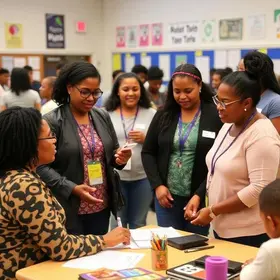
Parental Involvement in Public Schools: 2026 Update
Explore the latest 2026 trends, research, and strategies shaping parental involvement in public schools and student success.