Parenting and Learning Issues

Each child learns differently. Here we offer resources on learning styles and the classroom models that support them, expert advice on how to improve learning, and tips on parental involvement.

View the most popular articles in Parenting and Learning Issues:

Challenging Your Gifted Student

Updated
|
Challenging Your Gifted Student
Gifted students often fail to thrive in traditional academic environments because they are not being challenged. In this article you will learn how to make sure your gifted student gets the quality education he or she deserves.
Gifted students need to be challenged.

A commonly cited statistic suggests that as many as 20% of high school dropouts are gifted students. Does this statistic surprise you? On one side of the coin, you might think that gifted students would be more likely to excel in school than traditional students. On the other side of the coin, it makes sense that gifted students might drop out of school if they are not properly challenged. If you are the parent, guardian, or teacher of a gifted student then it is your duty to make sure they are pushed hard enough to meet their maximum potential.

Myths and Misconceptions

The statistic quoted earlier could be interpreted in different ways. Some might assume that gifted students will excel no matter what kind of schooling they receive while others might be able to see that gifted students are often bored in traditional classrooms which leads to a higher dropout rate. Before getting into the details regarding how to properly challenge a gifted student, it is important to address some common myths and misconceptions about gifted students.

This video discusses teaching gifted students.

  • Gifted students will do fine in normal classrooms. According to a study conducted by the Fordham Institute, over 50% of teachers have not received any professional development in regard to teaching gifted students. Furthermore, nearly 75% of those same teachers admitted that the brightest students in their classrooms are often bored or
. . .read more

Secrets of Spelling Bee Champs

Updated
Secrets of Spelling Bee Champs
Discover the secrets of spelling bee champs in 2026, including study strategies, word patterns, and proven techniques for student success.

This article has been updated to reflect 2026 data and recent developments.

Spelling bees continue to be a cornerstone of academic competition in public schools, promoting vocabulary development, language mastery, and confidence in young learners. While the fundamentals of success remain consistent, recent trends show that today’s spelling bee champions are combining traditional study habits with modern tools and linguistic strategies.

Understanding the secrets of spelling bee champs can help students, parents, and educators support stronger literacy outcomes both inside and outside the classroom.

Why Spelling Bees Still Matter in 2026

Spelling bees are more than competitions, they reinforce core literacy skills that are essential for long-term academic success. According to recent data from the National Assessment of Educational Progress, vocabulary and reading comprehension remain closely linked, with students demonstrating stronger spelling skills often outperforming peers in reading assessments.

In the post-pandemic learning environment, schools are placing renewed emphasis on foundational literacy. Spelling bees offer a structured and engaging way to strengthen:

  • Vocabulary acquisition
  • Pattern recognition
  • Memory and recall
  • Public speaking confidence

Many districts have also reintroduced or expanded spelling bee programs as part of broader literacy recovery initiatives.

Core Study Habits of Spelling Bee Champions

While technology has evolved, the foundational habits of top spellers remain remarkably consistent.

Consistent, Structured Practice

Spelling bee champions dedicate time daily to studying word lists and reviewing previous material. Rather than cramming, they focus on incremental learning and repetition.

Effective routines often include:

  • Daily word study sessions
  • Weekly cumulative reviews
  • Practice tests under timed
. . .read more

Co-teaching Offers New Opportunities for Students with Special Needs

Updated
Co-teaching Offers New Opportunities for Students with Special Needs
Although there are some drawbacks, co-teaching is an effective way to help special education students succeed in mainstream classrooms.

Co-teaching is an inclusive education model in which students with special education needs are provided the opportunity to learn in a mainstream classroom with the additional support of a special education teacher who co-teaches with the general education teacher. This model has proven successful in many school districts for several reasons.

Benefits for students with special education requirements

First of all, the co-teaching model ensures that students with special needs have access to the general education curriculum. By law students with disabilities must be provided access to learning opportunities that do not restrict their ability to progress in a subject or grade level. In a co-taught class, special education students have the opportunity to move from modified assignments to typical assignments as they develop skills and confidence. As a result, co-taught special education students are generally more likely to meet grade-level standards.

While they have access to the mainstream curriculum, co-taught students also continue to receive specialized instruction. Special education teachers within the mainstream classroom can coach students individually, or in small groups, providing them the additional coaching and guidance necessary for them to complete activities and assignments.

Differentiated instruction

In addition to in-class support for mainstream assignments, co-taught students also have the opportunity to grow within the curriculum through differentiated instruction. Since there are two teachers in the class, the same material can be taught in two or more different ways. The special education teacher can anticipate student needs and, in planning lessons with the mainstream teacher,

. . .read more

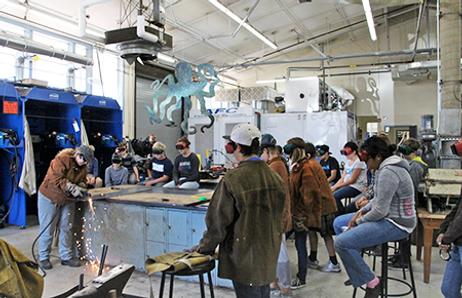
Life Beyond High School: The Innovative Frontier

Updated
|
Life Beyond High School:  The Innovative Frontier
Exploring post graduation options for high school students.

Crafting a Plan Beyond High School

As high school students prepare for life beyond their public or private schools, it is critical that they have a plan in place for their future. While many students are encouraged to pursue more of an academic route following their graduation, there are other more suitable options available to help them select a more suitable path. Around the country, more programs are offered to provide students choices about their career paths which include but are not limited to apprenticeships, internships, vocational trade schools, community colleges, and four-year colleges.

Having a plan for life after high school is crucial for students prior to reaching their senior year. Helping students hone in on their unique interests and skillsets are all components they need when recognizing and defining future goals. Most importantly, they need to be able to articulate their goals. Many school systems look at several factors as they attempt to direct students towards being ready to pursue either the workforce or further their education.

  • What are the student’s grades like?
  • Do they have a strong community or family support?
  • What are their academic strengths or weaknesses?
  • Are they able to communicate their decisions and thoughts to others effectively?
  • What are their genuine interests?

Vocational Schools

Vocational schools specialize in offering very specific skillset options for students while also ensuring completion towards certification and a high school diploma. There is no need for students to spend part of their day in their zoned school and the

. . .read more

5 Ways Parents Can Inspire Children to Love Reading

Updated
|
5 Ways Parents Can Inspire Children to Love Reading
Children are reading less and less in this country, and the effects of that are showing in their performance in school. However, there are a variety of ways parents can encourage their children to read – and hopefully to love reading!

This article has been updated to reflect 2026 data and recent developments.

There has been a substantial decline in the number of children who read for pleasure in the last few years. According to recent editions of Scholastic’s Kids & Family Reading Report, reading for fun has declined over the past several years. Today, only about half of children in the United States report enjoying reading for fun. A full 37% of children like to read “a little,” while 12% report not liking reading at all.

When it comes to reading, kids can come up with a million excuses as to why they don’t like it. It’s boring. There isn’t enough time. It isn’t fun. There’s already too much reading in school.

Thankfully, there is an art to promoting reading. Some methods, like nagging, definitely do not work. Yet other methods, such as modeling reading behaviors to your child, will pay dividends in the short and long term.

What NOT To Do

It can be frustrating trying to get your child to read, and in those moments, it is easy to rely on unsuccessful methods for encouraging reading. Sometimes the first inclination is to nag your child into submission, or perhaps bribe them to read by offering them a reward for doing so. Unfortunately, these methods often do more harm than good. Nagging can easily wear on your child’s nerves and lead him or her to resent the fact that they are being forced to read.

. . .read more

Recent Articles

AI Report Cards: Should Schools Evaluate AI Use?
Explore whether schools should assess student AI use, the benefits, risks, and what responsible AI report cards could look like in 2026.
The Parent’s Guide to School Cell Phone Bans in 2026
Learn how school cell phone bans work in 2026, why districts are adopting them, and what parents should expect.
Parental Involvement in Public Schools: 2026 Update
Explore the latest 2026 trends, research, and strategies shaping parental involvement in public schools and student success.

Parenting and Learning Issues

IMPROVING LEARNING
A comprehensive look at the latest trends, expert advice and recent studies into improving student learning. Explore the latest studies into links between student performance, sleep and music. See why schools are opting for later start times and year round schedules.
PARENTAL INVOLVEMENT FROM K-12
Learn how direct involvement in your child’s education can impact school performance. Get expert advice on how to get involved, learn why and when you need to talk to a teacher and ways to make changes on campus.
BULLYING
An overview of bullying in schools, laws to protect students, and the impact on education. This section provides great tips on protecting your child from being bullied or becoming a bully. Learn about the latest anti-bullying laws and see how cyber-bullying effects your child’s school performance.
TYPES OF LEARNING
What type of learner is your child? Be in the know about different types of learning and which classrooms are best suited for each type. What is project-based learning? Cooperative Learning? Would your child benefit from a blended learning experience? Explore these teaching techniques and learn how they could improve your child’s performance.
KINDERGARTEN AND ELEMENTARY ISSUES
Weigh the pros and cons of preschool, full day kindergarten and other issues affecting our youngest learners. Learn what can be done to help your child prepare to enter school, boost confidence, and encourage reading at the grade school level.
HIGH SCHOOL ISSUES
Learn more about issues specific to high school students. Get an overview of high school graduation rates, college readiness, career choice and social issues impacting teenagers in public schools.

Notice: Javascript file does not exist: /home/devsarath/workspace/psr/public_html/javascript/components/popper.min.js in /home/devsarath/workspace/shared/misc/JSCompiler.inc.php on line 242

Notice: Javascript file does not exist: /home/devsarath/workspace/psr/public_html/javascript/components/tippy.min.js in /home/devsarath/workspace/shared/misc/JSCompiler.inc.php on line 242

Notice: Directory does not exist in /home/devsarath/workspace/shared/misc/JSCompiler.inc.php on line 242

Notice: Unable to save compiled js file in /home/devsarath/workspace/shared/misc/JSCompiler.inc.php on line 242