School Discipline Policies

Examine the various discipline methods being put to use in public schools. From detention to expulsion, spanking to handcuffing, school discipline can often be controversial. Does spanking work? Do police belong in schools? Learn more about what is being done to punish out of control students.

View the most popular articles in School Discipline Policies:

Understanding Public School Lotteries, Magnet Programs & Dual-Language Schools

Updated
|
Understanding Public School Lotteries, Magnet Programs & Dual-Language Schools
A comprehensive 2025 guide for parents on public school lotteries, magnet programs and dual-language schools: how they work, benefits and how to apply.

Understanding Public School Lotteries, Magnet Programs and Dual-Language Schools

When families explore public-school options beyond their neighborhood zone, three major pathways often appear: lotteries, magnet programs and dual-language schools. Although each mechanism has its own logic, they share a common aim: offering additional choice, access and educational enrichment within the public-school system. This article—current for 2025—explains how each works, what parents and students should know, and how to navigate the process effectively.

1. What is a public school lottery?

Why a lottery?

When demand for a certain program or school exceeds available seats, many school districts resort to a lottery system to allocate spots fairly and transparently. As one guide explains: “A school lottery is a process that districts use when more students apply for a program than there are available seats.”

The lottery serves multiple functions:

  • It facilitates school-choice options within the public system (rather than strictly attending one’s zoned school).

  • It helps districts manage capacity, maintain demographic balance and meet equity goals.

  • It ensures the allocation process is not purely first-come, first-served (which may disadvantage families with fewer resources).

How does the lottery process work?

While specifics differ by district, most lotteries follow a similar outline:

  1. Families submit an application listing one or several preferred schools/programs.
. . .read more

Schools Demand Students' Social Media Passwords

Updated
|
Schools Demand Students' Social Media Passwords
Recent legislation that allows Illinois public schools to demand students’ social media passwords has renewed the debate about students’ right to privacy at school.

It is a story that is all too often in the news: A child is subjected to torturous cyberbullying by his or her peers via social media. Threatening messages sent on Facebook, humiliating comments about their appearance on Twitter, and other such nonsense drives the student to lash out, possibly hurting themselves, their peers, or both.

Schools no doubt serve a protective function and are charged with ensuring students have access to a free, appropriate education in an environment that is safe, secure, and nurturing. To help achieve that end, some states are taking strong measures to bolster the authority and power of school districts with regard to investigating instances of bullying, even if such negative behaviors do not occur on school property or within the bounds of the school day.

The Illinois Law

In an attempt to curb cyberbullying behaviors, the Illinois General Assembly passed a law, enacted January 1st of this year, that allows public school districts to demand access to students’ personal social media accounts if the student is suspected of violating school rules.

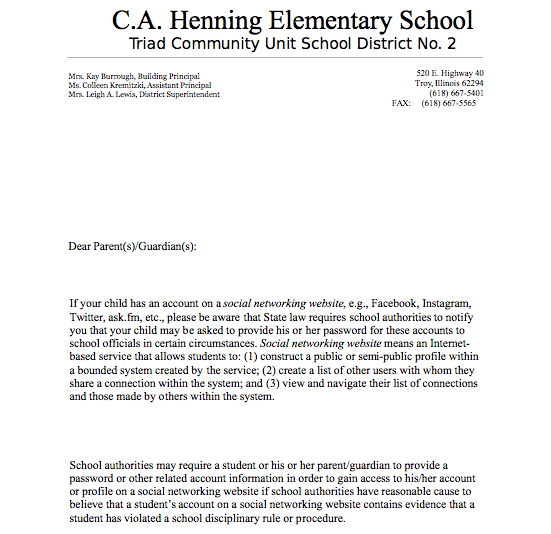
A letter sent home to parents in Triad Community Schools in Illinois, obtained by Motherboard, outlines the new policy:

“School authorities may require a student or his or her parent/guardian to provide a password or other related account information in order to gain access to his/her account profile on a social networking website if school authorities have reasonable cause to believe

. . .read more

Students of Color Disproportionately Disciplined in Schools

Updated
|
Students of Color Disproportionately Disciplined in Schools
Research shows that students of color face a disproportionate number of disciplinary actions in U.S. public schools. Learn about these disparities, as well as the policies that fuel them. Also learn about suggested measures to address this problem.

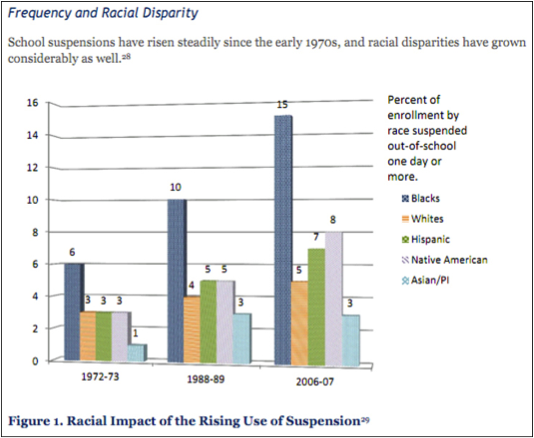
According to a 2014 report by the U.S. Department of Education’s Civil Rights Office, widespread racial disparities exist in how schoolchildren are punished. The longitudinal study looked at data from the past 15 years and found that minority students face a disproportional number of disciplinary actions in schools across the country, from those in affluent suburban neighborhoods to those in the poorest urban areas.

These disparities have been known for some time in middle and high schools. However, this report reveals that unfair discipline procedures begin as early as preschool. The data, which was collected from 97,000 public schools across the country, paints a troubling picture:

  • Black and Latino students are consistently punished more severely than white students for the same infractions.
  • Nearly 50 percent of preschool children suspended multiple times are black, yet black children represent less than one-fifth of the preschool population.
  • Black students are far more likely to be referred to law enforcement or arrested for a school-based offense than white students or other students of color.
  • Black girls are suspended much more than girls of any other race.
  • Students with disabilities, who represent only 12 percent of the public school population, account for almost 60 percent of students placed in seclusion.

Zero-Tolerance Policies

Many students suspended or placed in involuntary seclusion are put there because of the zero-tolerance policies that schools have put in place over the last two decades. Zero-tolerance policies began initially as a response to major

. . .read more

The Look of Public Schools Post-Newtown: More Armed Guards Greet Students

Updated
|
The Look of Public Schools Post-Newtown: More Armed Guards Greet Students
Students have headed back to school across the country, but are greeted by new security technology and armed security guards. We take a look at Post-Newtown public education.

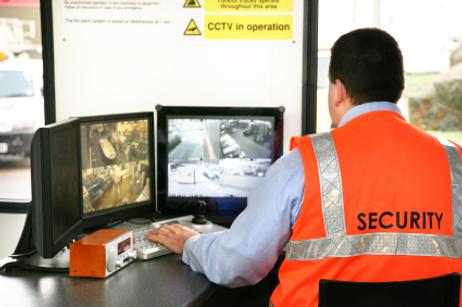
As students head back to school, things may look a little different in some locations. In the years following major school safety incidents, including Sandy Hook (2012) and Uvalde (2022), many districts across the country are looking for ways to strengthen school safety protocols to keep students and staff a little safer. In light of those efforts, students may be greeted by new security devices, safety measures, and even armed guards at some schools.

Debates Over Best Security Options

The Courant reports that as schools weighed their options in new security procedures, a debate over the best way to protect students and faculty ensued. Armed police guards are often the center of that debate, with some school officials in favor of the action and others opposed. Other issues that have been argued in recent years include proposals to arm school personnel and expand school resource officer programs.

This video from ABC News reports on the mounting cries nationwide for better security in our schools.

Carl Sferrazza, police chief for Enfield, Connecticut, is one who agrees that armed guards are the best way to keep students safe. Sferrazza told the Courant, “These people are homicidal and suicidal individuals. Their intent and their planning are all geared toward killing as many people as they possibly can.”

However, others liken placing armed guards at the entrances of schools to creating a prison-like atmosphere

. . .read more

Testing Students for Alcohol Use: Violation of Constitutional Rights?

Updated
|
Testing Students for Alcohol Use: Violation of Constitutional Rights?
A private school in Illinois will begin randomly testing students for alcohol use this year, raising the issue of the constitutionality of drug and alcohol testing in schools once again.

A private high school in Illinois is raising the stakes on testing. However, the testing in question is not standardized examinations or even pop quizzes in the classroom. This school is adding testing for alcohol consumption to its current tests that randomly screen students for drug use.

Hair Test Detects Alcohol Consumption

The Huffington Post reports that St. Viator High School in Arlington Heights, Illinois, will unveil its random alcohol testing at the start of the new school year. The private Catholic high school has been testing students for drug use for several years and now will use a similar test to check up on students’ alcohol consumption. The alcohol test is a new addition, and the high school will be one of the first in the country to try out this new testing method.

“We’re adding this test because we care about our kids, and we want them to be the best God created them to be,” St. Viator President Corey Brost said at the Huffington Post.

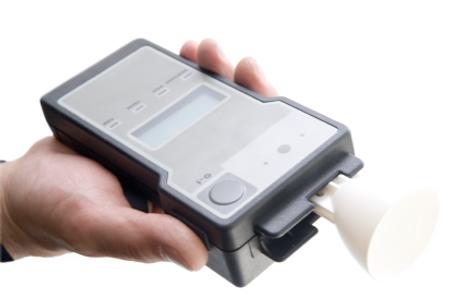
This video describes how Southington High School in Southington, Connecticut, will use a $600 alcohol-detection device similar to a Breathalyzer to screen students for alcohol consumption.

The new test will use hair samples, about the width of pencil lead, to reveal any alcohol use by the student. The test provides information about students who have had two to three drinks a week

. . .read more

Recent Articles

AI Report Cards: Should Schools Evaluate AI Use?
Explore whether schools should assess student AI use, the benefits, risks, and what responsible AI report cards could look like in 2026.
The Parent’s Guide to School Cell Phone Bans in 2026
Learn how school cell phone bans work in 2026, why districts are adopting them, and what parents should expect.
Parental Involvement in Public Schools: 2026 Update
Explore the latest 2026 trends, research, and strategies shaping parental involvement in public schools and student success.

Notice: Javascript file does not exist: /home/devsarath/workspace/psr/public_html/javascript/components/popper.min.js in /home/devsarath/workspace/shared/misc/JSCompiler.inc.php on line 242

Notice: Javascript file does not exist: /home/devsarath/workspace/psr/public_html/javascript/components/tippy.min.js in /home/devsarath/workspace/shared/misc/JSCompiler.inc.php on line 242

Notice: Directory does not exist in /home/devsarath/workspace/shared/misc/JSCompiler.inc.php on line 242

Notice: Unable to save compiled js file in /home/devsarath/workspace/shared/misc/JSCompiler.inc.php on line 242