Online learning has become a popular way for many college students to earn a degree, but it is also making its way into many primary and secondary schools as well. With the continued presence of virtual public schools and cyber-charter schools nationwide, some public school districts are turning to cyber-education as a means of competing with other schools in their areas. But is online education the answer for public schools today? The answer depends on who you ask.
What is Cyber-Education?
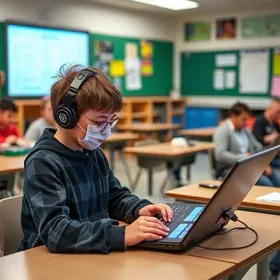
According to K12, an online school provider, cyber or virtual schooling takes place on the Internet, rather than in a traditional classroom. Students go online from anywhere they choose, allowing them to keep up with schoolwork from home or on the road. Access to teachers is completed through phone calls, online conferencing, or face-to-face in some instances. Teachers who work in cyber-schools are typically state-certified and oversee virtual classrooms, where students often have the opportunity to interact with their instructors and peers.
While cyber-schools maintain a sense of structure in their virtual classrooms, there is flexibility in education that is not seen in a brick-and-mortar classroom. The success of students in cyber-education rests more squarely on parents, who must ensure students remain focused even if they are doing their learning from the comfort of home. However, unlike homeschooling, parents do not act as instructors in the cyber-school experience.
Families comparing online and in-person options may also want to review Public School Review’s guide to digital learning and public schools.
The Benefits of Cyber-Schooling
Those who have participated in cyber-schooling tout numerous benefits with the model, including:
- The ability to individualize lessons to a student’s ability and learning pace
- Students who are unable to attend traditional classrooms due to illness or disability don’t have to fall behind in school
- Students can keep up with their studies during travel
- Cyber-schools offer the opportunity to get a quality education without fear of getting picked on or bullied
- These virtual classrooms allow students to get the bulk of their influence from home, through parents and siblings
“I think the education is a lot better,” Cameron, an 11-year-old student at Pennsylvania Leadership Charter School, told Lehigh Valley Live. “My favorite part is being home and learning about science because I can research the things I am doing.”
For those concerned about social interaction, many cyber-schools include a network of parents that organize outings, field trips, and other events that allow students to get together in a face-to-face environment. Some cyber schools also provide on-site activities that allow students and teachers to connect on a personal level. For example, Pennsylvania Leadership Charter School offers extracurricular activities, including a performing arts program and honors classes, at its Pennsylvania building.
Online schooling excels in situations where it is impossible for students to attend school for in-person teaching. The pandemic of 2020-2021 showed both the usefulness and the limits of digital teaching. It was not perfect. It is assumed that every student had access to a robust internet connection. But for many students, it was better than no instruction at all.
Online Education in Charter Schools
Charter schools are one of the most popular types of schools for cyber-education since they traditionally tend to march to their own drum in the world of academia. Families weighing this option can review Public School Review’s overview of what a charter school is.
These schools can take the funding they receive from the state and apply it to a virtual classroom that costs much less to run than a brick-and-mortar building. In Pennsylvania, cyber-charter funding and oversight remain active policy issues. The Pennsylvania Department of Education maintains annual cyber charter reports and 2025-2026 enrollment data for the state’s charter sector.
Students who decide to attend cyber-schools may receive the equipment and supplies they need to get started at no cost. However, some educators continue to argue that cyber-schools take funding directly out of the hands of traditional public schools at a time when those classrooms need the money most. Other educators are examining ways the public school system can compete with popular cyber-charter schools by offering their own alternatives in online education.
Public School Review’s article on virtual charter schools offers a closer look at the advantages and concerns families should consider.
In-Person Versus Online Education
In Pennsylvania, where cyber-charter schools have been particularly popular, other public schools have offered their own version of virtual education in order to compete. Superintendents have found that cyber-education may be one way to compete with charters offering expanded course options and other perks, especially in light of tight school budgets.
Because taxpayer dollars move to charter schools with every student who enrolls in cyber-education, some school systems are doing everything in their power to bring those students, and their funding, back to the public schools in the state.
In addition, Pennsylvania districts have touted the benefits of online education through traditional schools, citing weak performance at some cyber schools throughout the state. In 2026, that debate continues to center on accountability, funding formulas, student outcomes, and the appropriate role of full-time virtual schooling.
Parents comparing options may also find Public School Review’s guide to online learning opportunities in public schools useful.
Oversight of Cyber-Schools
In Michigan, the popularity of cyber-education has led to ongoing attention to how virtual learning is monitored. Michigan Virtual reported that returning schools generated 976,063 virtual enrollments in 2024-25, with a 65% pass rate, two percentage points higher than in 2023-24.
Nationally, the National Center for Education Statistics reported that in the 2022-23 school year, 7% of enrolled or homeschooled K-12 students took at least one virtual course, while 3% took all courses virtually.
With technology permeating every aspect of our culture today, cyber-schooling will remain another way of delivering K-12 education, especially in situations and times when it is not possible to attend in-person classes. While the verdict is still out on whether full-time online schools are an effective way of educating all students, there is no doubt that virtual education is now a permanent part of the public school landscape.
Conclusion
Cyber-education has evolved from a niche alternative into a permanent part of the public education system. While concerns about funding, accountability, and student outcomes remain, virtual learning continues to offer flexibility and access for many families. As technology improves and public schools refine their online programs, cyber-schooling will likely remain an important educational option alongside traditional classroom instruction.