Updated
|
Should My Child Graduate Early?
Learn about the pros and cons of graduating early from high school.

Whether your child is academically gifted or is simply eager to get a head start on college, many teens are choosing to graduate from high school early. Some parents are concerned that early graduates miss out on important social elements of high school; however, the potential academic, collegiate and financial benefits are often quite redeeming.

The Benefits of Early Graduation

While early graduates may miss out on traditional hallmarks of prom or other formal ceremonies, students across the country are striving for early high school graduation rates in order to save money and get ahead. According to Natasha Robinson of The News and Observer, one young female worked to receive some serious financial benefits in graduating early: “Kylee Patterson graduated from high school with a full year of college already completed - a move that saved her $15,000 on tuition and books.” By taking community college and AP courses that qualified both for high school and college credit, Kylee was able to not only graduate from high school early but get a jump on college as well.

As tuition costs soar for college courses, taking AP classes provides students with the opportunity to earn college credit while still in high school—and without having to pay for the costs. Paired with this, many high schools are now allowing advanced and honors students to take community college courses to meet their high school degree requirements; in such cases, the high schools often pay for the college

. . .read more

Online Learning in Public High Schools

Updated
|
Online Learning in Public High Schools
We explore the diverse range of online learning opportunities available to high school students, including virtual classrooms, interactive coursework, and digital resources.

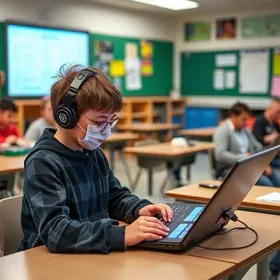
As public schools embrace technology's evolving availability and convenience, many high schools are implementing online courses to cater to more students. Recently, researchers from Harvard suggest that “while only about 1 percent of courses in 2007 were online, this figure represents a 22-fold increase from 2000 and should grow to 10 percent within six years and to about 50 percent by 2019.”

Furthermore, as the public policy research center at Stanford University projects, the rising affordability of technology may result in nearly half of all high school courses being available online.

In this enlightening article, we delve into the realm of online learning and its growing significance in public high schools. We explore the diverse range of online learning opportunities available to high school students, including virtual classrooms, interactive coursework, and digital resources. From advanced placement (AP) courses to specialized electives and credit recovery programs, online learning offers flexibility, personalized instruction, and expanded educational horizons. We discuss the benefits and challenges of online learning, highlighting its potential to foster self-directed learning, enhance digital literacy, and accommodate diverse learning styles. Furthermore, we examine the strategies public high schools employ to implement and integrate online learning effectively while addressing equity concerns and ensuring student success. Join us as we navigate the world of online learning in public high schools and uncover the transformative potential it holds for students seeking innovative educational opportunities.

This video explains how and why high schools are using online learning.

. . .read more

Technology in Public Schools

Warning: mkdir(): Permission denied in /home/devsarath/workspace/psr/public_html/include/srn_lib/psr/misc/QuickPhotos.inc.php on line 24 Warning: mkdir(): Permission denied in /home/devsarath/workspace/psr/public_html/include/srn_lib/psr/misc/QuickPhotos.inc.php on line 24 Warning: mkdir(): Permission denied in /home/devsarath/workspace/psr/public_html/include/srn_lib/psr/misc/QuickPhotos.inc.php on line 24 Warning: mkdir(): Permission denied in /home/devsarath/workspace/psr/public_html/include/srn_lib/psr/misc/QuickPhotos.inc.php on line 24
Updated
|
Technology in Public Schools
Whether you're a parent, educator, or education enthusiast, join us as we uncover the transformative potential of technology in public schools and the strategies for securing sustainable funding to ensure equal access and enhanced learning experiences for all students.

In recent years, the technology investment in public schools, ranging from K-12 institutions, has grown astronomically. According to Equity Review research, in 1998 alone, “the level of spending on educational technology at the national level was estimated at over $5 billion,” and it has grown each year in the last decade.

While each school’s budget is diverse and unique, programs have been implemented to balance the rising costs of technology and education, aiming to provide all students with equitable access to a learning environment with modern and interactive equipment.

This illuminating article delves into the dynamic landscape of technology implementation and funding in public schools. We examine the various ways technology is being integrated into educational settings, ranging from interactive whiteboards and online learning platforms to coding programs and virtual reality experiences. We also explore the challenges and opportunities associated with funding technology initiatives, considering budget constraints, equity concerns, and the evolving needs of students and educators. By showcasing real-life examples and innovative approaches, we shed light on successful models and best practices that can inspire and guide schools in their technology adoption journey. Whether you're a parent, educator, or education enthusiast, join us as we uncover the transformative potential of technology in public schools and the strategies for securing sustainable funding to ensure equal access and enhanced learning experiences for all students.

Federal Funding in Public Schools

According to the “Resource Guide to Federal Funding for Technology in Public Schools,” a five-year, $2 billion

. . .read more

Academic Clubs in Public Schools

Updated
|
Academic Clubs in Public Schools
Learn about the growing trend of academic clubs in public schools.

While sports have always been a staple in public schools, many students are taking advantage of non-athletic opportunities, such as academic sports. Both athletes and non-athlete students are discovering that the latest public school clubs are not only building students’ profiles for college applications, but they’re also providing rare opportunities for travel, competitions, awards, and even college scholarships!

Academic Clubs

An academic club is essentially any school-approved group of students, often with a faculty sponsor, who meet to develop activities or discussions based on their particular topic of interest. Group meetings are often informal, and can even involve after-school field trips, community volunteerism opportunities, or other venues. The intent of an academic club is to generate enthusiasm for a topic while encouraging student involvement and achievement.

While in the past, most academic clubs were based on school subjects, such as the book club, the math club, or the science club, public schools today have a much greater scope in clubs – and even geared towards gifted students. For example, springing up around campuses are “Robotics Clubs,” where students actually design a robot and compete in competitions. Another forum for clubs is technology-based, where “Gaming Clubs,” “Computer Design Clubs,” or “Web Clubs,” have grown in popularity; students not only learn about how the technology works, but they’re also able to have some fun, as they learn to design their own personal or professional web pages or computer-based games.

This video offers suggestions for school

. . .read more

Parent-Teacher Conferences

Updated
|
Parent-Teacher Conferences
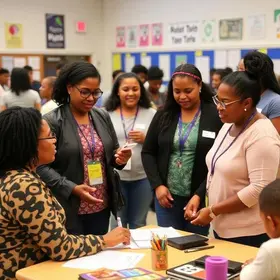
We offer some tips for when, how, and how often to have a parent-teacher conference.

As parents struggle to navigate the balance of fostering their child’s autonomy, versus being actively involved, the timeliness and appropriateness of meeting with a child’s teachers is highly dependent upon a child’s age, his or her behavior, and potential special needs. Whether a child is gifted, struggling, or displaying average abilities play a large factor in determining when to intervene and meet with school leaders.

This video offers an example of a parent-teacher conference.

When to Meet with a Teacher

  • Collaborating Insights

If you have serious and pressing concerns about your child’s behavior, his or her academic progress, or other specific or general concerns, teachers can provide a great deal of insight into your child’s behavior. According to Terri Mauro, the author of The Everything Parent’s Guide, “If you have a pressing concern that needs to be addressed right away, don't delay in requesting a meeting yourself.”

Surprisingly, teachers may actually see your child at more constant time frames throughout the day than most parents; once kids are at home, they may play with friends away from supervision, or they may play in their rooms with the door closed. As a result, meeting with a teacher to find out his/her observations about your child’s behavior can help ameliorate concerns, and bring problems to the forefront, while working to brainstorm solutions for success.

  • Early Communication to Foster Success

According to the Child Development Institute, “The

. . .read more

Recent Articles

The ROI of Public High School in 2026: Which Programs Actually Improve College and Career Outcomes?
Which public high school programs deliver real college and career results in 2026? Compare AP, IB, dual enrollment, CTE, and early college outcomes.
Spring Parent-Teacher Conferences: Key Questions
Spring Parent-Teacher Conferences: Questions Every Parent Should Ask to support academic growth, social development, and 2026 classroom goals.
Prepare for Spring Tests Without Anxiety
Learn how to prepare for spring standardized tests without increasing anxiety using proven strategies for families and schools.
Notice: Javascript file does not exist: /home/devsarath/workspace/psr/public_html/javascript/components/popper.min.js in /home/devsarath/workspace/psr/public_html/include/srn_lib/shared/misc/JSCompiler.inc.php on line 241 Notice: Javascript file does not exist: /home/devsarath/workspace/psr/public_html/javascript/components/tippy.min.js in /home/devsarath/workspace/psr/public_html/include/srn_lib/shared/misc/JSCompiler.inc.php on line 241 Notice: Directory does not exist in /home/devsarath/workspace/psr/public_html/include/srn_lib/shared/misc/JSCompiler.inc.php on line 241 Notice: Unable to save compiled js file in /home/devsarath/workspace/psr/public_html/include/srn_lib/shared/misc/JSCompiler.inc.php on line 241